Click Here! RAMANA Study Point

Search This Blog

Sunday, 24 July 2011

Beaches of India


g
West coast

Gujarat
The beaches along the western state of Gujarat are:

Ahmedpur Mandvi Beach
Chorwad Beach
Diu Beach
Gopnath Beach
Umbergam Beach
Tithal Beach

Maharashtra
The state of Maharashtra has

Maigund Beach
Dahanu Beach
Palghar Beach
Kelwa Beach
Arnala Beach
Suruchi Beach, Vasai
List of Mumbai beaches
Manori Beach, Mumbai
Gorai Beach, Mumbai
Madh Island's beach, Mumbai
Marvé Beach, Mumbai
Aksa Beach, Mumbai
Versova Beach, Mumbai
Juhu beach, Mumbai
Band Stand, Mumbai
Dadar Chowpatti, Mumbai
Girgaum Chowpatty Beach, Mumbai
Uran Beach, Navi Mumbai
Khim Beach, Mumbai
Alibaug Beach
Akshi Beach, Mumbai
Revdanda Beach
Kashid Beach
Murud Janjira Beach
Adgaon Sea Beach
Velas Beach
Diveagar Beach
Aravi Beach
Shreewardhan Beach
Harihareshwar Beach
Bankot Beach
Padale Beach
Harne Beach
Palande Beach
Murud Harnai Beach
Ladghar Beach
Guhagar Beach
Palshet Beach
Bhudal Beach
Welneshwar Beach
Hedavi Beach
Narvan Beach
Nadivade Beach
Malgund Beach
Ganpatipule Beach
Dhokamle Beach
Mandvi Beach
Bhatye Beach
Mervi Beach
Padavane Ambolgad Beach
Madban Beach
Vijaydurg Beach
Kotharwadi Beach
Devgad Beach
Mithamumbari Beach
Kunkeshwar Beach
Tambaldegh Beach
Achara Beach
Chivla Beach
Malvan Beach
Tarkarli Beach
Devbag Beach
Bhogve Beach
Kalvi Beach
Vaingani Beach
Dabholi Beach
Sagareshwar Beach
Kurlevadi Beach
Redi Beach
Kondura Beach
Mochemad Beach
Shiroda Velagar Beach
Arevare Seaface and Beach
Varavde Beach
Ganeshgule Beach
Anjarlay Beach
Kuravde Beach
Kondavli Beach
Agardanda Beach

Goa
The beaches in the state of Goa are listed below.

Arambol Beach
Palolem Beach
Calangute
Benaulim
Candolim
Chapora Beach
Dona Paula
Miramar, Panaji
Anjuna Beach
Vagator Beach
Varca Beach
Majorda Beach
mobor Beach
Cavelossim Beach
Vagator Beach
Nerul or Cocco Beach

Karnataka

Karwar Beach, Karnataka
Om beach, Gokarna
Murudeshwara
Kaup (village)
Kudle beach
Maravanthe
Malpe Beach, Udupi
Mukka
Panambur
St Mary's Island, Karnataka
Tannirubhavi Beach
Trasi
Ullal

Kerala
The beaches in Kerala state, known as God's own country, are:

Stone Pavilion at Sangumukham beach, Trivandrum
Alappuzha Beach
Cherai Beach
Fort Kochi, Cochin
Kappad
Kappkadavu
Kovalam, Trivandrum
Marari beach
Meenkunnu Beach
Muzhappilangad Beach
Payyambalam Beach
Shangumughom Beach, Trivandrum
Varkala, Trivandrum
Veli beachside lagoon, Thiruvananthapuram (Trivandrum)
See also : Beaches in Kerala

East coast

Tamil Nadu

The sandy shores at the Gulf Of Mannar, Dhanushkodi, Tamil Nadu
The beaches in the southern state of Tamil Nadu are:

Marina Beach, Chennai
Golden Beach, Chennai
Adyar Beach, Chennai
Thiruvanmiyur Beach, Chennai
Elliot's Beach, Chennai
Santhome Beach, Chennai
Thiruvottiyur Beach, Chennai
Kovalam Beach, Kovalam
Mahabalipuram Beach, Mahabalipuram
Ennore Beach, Ennore
Silver Beach, Cuddalore
Kanyakumari Beach, Kanyakumari (Both East and West coast)
Tiruchendur Beach, Tiruchendur
Velankanni Beach, Velankanni
Poombukar (Mayavaram) Beach Poombukar
Pondicherry Beach
Portonova Beach, Parankipatai
Tranqbar Beach, Tharangambadi
Nagapattinam Beach

Andhra Pradesh
The following are the beaches in Andhra Pradesh, India

Baruva, Srikakulam
Bhavanapadu, Srikakulam
Kalingapatnam, Srikakulam
Kallepalli, Srikakulam
Mypad Beach
Mogadalapadu, Srikakulam
Salihundam, Srikakulam
Sri Kurmam, Srikakulam
Suryalanka Beach, Bapatla
Vizag beach, Vizag
Ramakrishna Mission beach,
Tenneti beach, Vizag
Submarine Museum beach, Vizag
Dolphins Nose beach, Vizag
Manginapudi beach, Machilipatnam
Kakinada beach, Kakinada

Orissa
The beaches in Orissa are:


Cheena vala
Chandipur Beach
Gopalpur Beach
Gahirmatha Beach
Puri Beach

Others
Colva Beach, Margao, India
Andaman & Nicobar, India
Panayur Beach

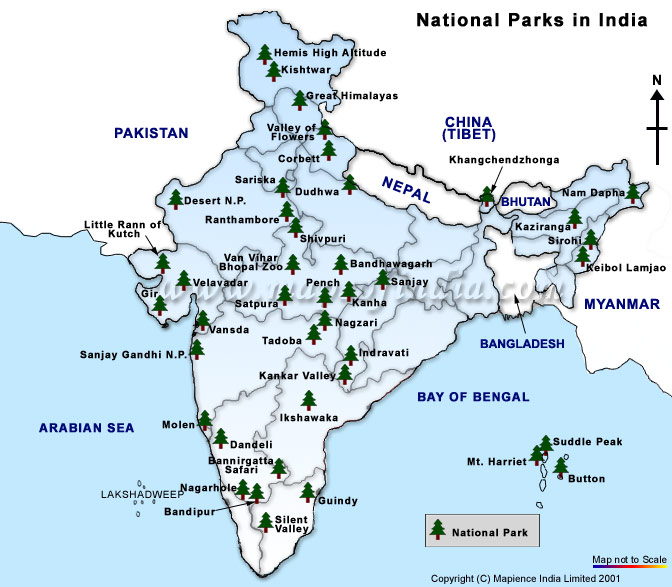
List of National Parks in India


This is a list of all national parks of India. India's first national park (an IUCN category II protected area) was established in 1936 as Hailey National Park, now known as Jim Corbett National Park. By 1970, India only had five national parks. In 1972, India enacted the Wildlife Protection Act and Project Tiger to safeguard the habitats of conservation reliant species. Further federal legislation strengthening protections for wildlife was introduced in the 1980s. As of April 2007, there are 96 national parks. All national park lands encompass a combined 38,029.18 km², 1.16% of India's total surface area.
A total of 166 national parks have been authorized. Plans are underway to establish the remaining scheduled parks. All of India's national parks are listed below alongside their home state or territory and the date that they were established. For an overview of Indian protected areas in general, please see protected areas of India.


Name State Established Area (in km²)
1. Anshi National Park Karnataka 1987 250
2. Balphakram National Park Meghalaya 1986 220
3. Bandhavgarh National Park Madhya Pradesh 1982 448.85
4. Bandipur National Park Karnataka 1974 874.20
5. Bannerghatta National Park Karnataka 1974 106.27
6. Vansda National Park Gujarat 1979 23.99
7. Betla National Park Jharkhand 1986 231.67
8. Bhitarkanika National Park Orissa 1988 145
9. Blackbuck National Park, Velavadar Gujarat 1976 34.08
10. Buxa Tiger Reserve West Bengal 1992 117.10
11. Campbell Bay National Park Andaman and Nicobar 1992 426.23
12. Chandoli National Park Maharashtra 2004 317.67
13. Corbett National Park Uttarakhand 1936 520.82
14. Dachigam National Park Jammu and Kashmir 1981 141
15. Darrah National Park Rajasthan 2004 250
16. Desert National Park Rajasthan 1980 3162
17. Dibru-Saikhowa National Park Assam 1999 340
18. Dudhwa National Park Uttar Pradesh 1977 490.29
19. Eravikulam National Park Kerala 1978 97
20. Fossil National Park Madhya Pradesh 1983 0.27
21. Galathea National Park Andaman and Nicobar 1992 110
22. Gangotri National Park Uttarakhand 1989 1552.73
23. Gir National Park Gujarat 1965 258.71
24. Gorumara National Park West Bengal 1994 79.45
25. Govind Pashu Vihar Uttarakhand 1990 472.08
26. Great Himalayan National Park Himachal Pradesh 1984 754.40
27. Gugamal National Park Maharashtra 1987 361.28
28. Guindy National Park Tamil Nadu 1976 2.82
29. Gulf of Kachchh Marine Gujarat 1980 162.89
30. Gulf of Mannar Marine NP Tamil Nadu 1980 6.23
31. Hemis National Park Jammu and Kashmir 1981 4100
32. Harike Wetland Punjab 1987 86
33. Hazaribag National Park Jharkhand 1954 183.89
34. Indira Gandhi National Park 
(prev: Annamalai National Park) Tamil Nadu 1989 117.10
35. Indravati National Park Chhattisgarh 1981 1258.37
36. Intanki National Park Nagaland 1993 202.02
37. Kalesar National Par k Haryana 2003 100.88
38. Kanha National Park Madhya Pradesh 1955 940
39. Kanger Ghati  (Kanger Valley) Chhattisgarh 1982 200
40. Kasu Brahmananda Reddy Andhra Pradesh 1994 1.42
41. Kaziranga National Park Assam 1974 471.71
42. Keibul Lamjao National Park Manipur 1977 40
43. Keoladeo National Park Rajasthan 1981 28.73
44. Khangchendzonga National Park Sikkim 1977 1784
45. Kishtwar National Park Jammu and Kashmir 1981 400
46. Kudremukh National Park Karnataka 1987 600.32
47. Madhav National Park Madhya Pradesh 1959 375.22
48. Mahatma Gandhi Marine 
(prev: Wandur National Park) Andaman and Nicobar 1983 281.50
49. Mahavir Harina Vanasthali Andhra Pradesh 1994 14.59
50. Manas National Park Assam 1990 500
51. Mathikettan Shola National Park Kerala 2003 12.82
52. Middle Button Island National Park Andaman and Nicobar 1987 0.64
53. Mollem National Park Goa 1978 107
54. Mouling National Park Arunachal Pradesh 1986 483
55. Mount Abu Wildlife Sanctuary Rajasthan 1960 288
56. Mount Harriet National Park Andaman and Nicobar 1987 46.62
57. Mrugavani National Park Andhra Pradesh 1994 3.60
58. Mudumalai National Park Tamil Nadu 1990 103.24
59. Mukurthi National Park Tamil Nadu 1990 78.46
60. Murlen National Park Mizoram 1991 200
61. Namdapha National Park Arunachal Pradesh 1983 1985.23
62. Nameri National Park Assam 1998 200
63. Nanda Devi National Park Uttarakhand 1982 630.00
64. Nandankanan National Park Orissa 1976
65. Navegaon National Park Maharashtra 1975 133.88
66. Neora Valley National Park West Bengal 1986 88
67. Nokrek National Park Meghalaya 1986 47.48
68. North Button Island National Park Andaman and Nicobar 1987 0.44
69. Orang National Park Assam 1999 78.80
70. Palani Hills National Park Tamil Nadu Proposed 736.87
71. Panna National Park Madhya Pradesh 1973 542.67
72. Pench National Park Madhya Pradesh 1975 292.85
73. Pench National Park Maharashtra 1975 257.26
74. Periyar National Park Kerala 1982 350
75. Phawngpui Blue Mountain Mizoram 1997 50
76. Pin Valley National Park Himachal Pradesh 1987 675
77. Rajaji National Park Uttarakhand 1983 820.42
78. Rajiv Gandhi National Park 
(prev: Nagarhole National Park) Karnataka 1988 643.39
79. Rani Jhansi Marine National Park Andaman and Nicobar 1996 256.14
80. Ranthambore National Park Rajasthan 1980 392
81. Saddle Peak National Park Andaman and Nicobar 1987 32.54
82. Salim Ali National Park Jammu and Kashmir 1992 9.07
83. Sanjay National Park² Chhattisgarh 1981 1471.13
84. Sanjay National Park² Madhya Pradesh 1981 466.88
85. Sanjay Gandhi National Park a.k.a.
 Borivili National Park, Mumbai Maharashtra 1983 86.96
86. Sariska National Park Rajasthan 1982 273.80
87. Satpura National Park Madhya Pradesh 1981 585.17
88. Silent Valley National Park Kerala 1984 89.52
89. Sirohi National Park Manipur 1982 0.41
90. Simlipal National Park Orissa 1980 845.70
91. Singalila National Park West Bengal 1992 78.60
92. South Button Island National Park Andaman and Nicobar 1987 0.03
93. Sri Venkateswara National Park Andhra Pradesh 1989 353.62
94. Sultanpur National Park Haryana 1989 1.43
95. Sundarbans National Park West Bengal 1984 1330.10
96. Tadoba National Park Maharashtra 1955 623
97. Valley of Flowers National Park Uttarakhand 1982 87.50
98. Valmiki National Park Bihar 1989 335.65
99. Kanwar Lake Bird Sanctuary Bihar 1987 67.5
100. Vikramshila Gangetic Dolphin Sanctuary Bihar 2009 250
101. Van Vihar National Park Madhya Pradesh 1979 4.45
102. Dalma Wildlife Sanctuary Jharkhand 1975 195

Major Mountain Ranges in India


Indian Mountains

Indian Mountains stand tall and regal and are said to represent some of the highest peaks in the world. Apart from protecting the country along its northern borders, the Indian mountains are also great tourist attractions for their scenic beauty.

Indian mountains are the integral parts that serve greatly in building the ecosystem. Indian Mountains have long added to the pristine beauty of the country, epitomizing majesty with their tall and regal presence. For centuries, these mountains have protected the nation`s borders from invading armies. The most dominant mountain ranges in the country are the Himalayan Mountain Ranges. The Northern side of the Indian Subcontinent is defined by the Himalaya Mountains, the Hindukush and the Patkai Ranges 

Major Mountain Ranges in India 
There are a total of eight major mountain ranges in India. All of these have peaks with a height of over 1000 feet.

Himalayan Mountain Range 
It is said to be the world`s highest mountain range. The Himalayas run from Arunachal Pradesh in the East to Jammu and Kashmir in the West. The mountains form India`s border on the north-eastern side and separate it from north-eastern Asia. These mountain ranges, said to be the youngest in the world cover an area of almost 5, 00,000 kilometres square. There are a number of peaks here over 7000 metres and the tallest peak of the range, Mt. Everest, lies along the Nepal-China border. 

Aravalli Mountain Range 
This is the oldest mountain ranges in India and runs for approximately 800 kms. It runs across Rajasthan in a northeast to southwest direction and the northernmost end of the range runs into Haryana and ends near Delhi. The highest peak of the Aravallis is the Guru Shikhar peak at Mount Abu. It rises to almost 1722 metres near Gujarat. 

Karakoram Mountain Range 
The Karakoram Range, lying in the state of Jammu and Kashmir, has over 60 peaks that stand at a height of over 7000 metres. Found here is the K2, the second highest peak in the world. Close to the north-western end of the Karakoram lays the Hindu Raj range and beyond this is the Hindu Kush Range. The Karakorams are bound on the South by the Gilgit, Shyok and Indus River. 

Vindhya Mountain Range 
The Vindhya Mountain Range lies along most of Central India and is believed to have been formed from the wastes created by the weathering of the Aravalli Mountains. It separates Northern India from the Southern part of the country and runs at an average height of 3000 metres. The Western end of the mountain range is located in Gujarat. 

Satpura Mountain Range 
The Satpura Mountain Range runs parallel to the Vindhya Range which lies to its North. The Satpuras begin in Eastern Gujarat and run east across Maharashtra, Madhya Pradesh and Chhattisgarh. These ranges run for 900 kms with a number of peaks which rise above 1000 metres. 

Patkai Hills or Purvanchal Ranges 
The Purvanchals, which lie along the eastern border that the country shares with Myanmar, was created by the tectonic process similar to the one which created the Himalayas. There are a total of three hill ranges which form part of the Patkai, and these are the Patkai-Bam, the Garo hills-Khasi hills-Jaintia Hills and the Lushai hills. The Patkai Mountains are characterised by conical peaks, steep slopes and deep valleys and are not as tall as the Himalayas. 

Western Ghats Mountain Range 
Also known as the Sahyadri Mountain Range this range runs along the western edge of the Deccan plateau in India. This range runs across Maharashtra, Goa, Karnataka, Kerala and Tamil Nadu to the southern tip of the Deccan peninsula. The average height of the mountains is around 1000 feet and the highest peak of the range is the Anaimalai Hills in Kerala standing at a height of 2,695 metres. 

Eastern Ghat Mountain Range 
Eastern Ghats mountain range in India does not run in a continuous line. They have been dissected by the four major rivers of South India- Krishna River, Godavari River, Kaveri River and Mahanadi River. These mountains extend from West Bengal to Orissa, Andhra Pradesh and Tamil Nadu, along the coast and parallel to the Bay of Bengal. Some of the peaks of the Eastern Ghats are over 1000 metres in height. 

Thus discussed above are the major mountain ranges in the country. These mountains, apart from the various geographic functions that they perform, also provide ample opportunities for eco-tourism. They offer scope for numerous adventure mountain activities such as trekking, skiing, skating, rock climbing and snow climbing. 

Usefulness of the Mountains 
The tallest mountain ranges act as a kind of natural barrier against the cold winds coming in from the poles. The Himalayas act as a barrier to the frigid katabatic winds flowing down from Central Asia. Thus, North India is kept warm or only mildly cooled during winter. The various rivers that originate in these mountains flow through the fertile Indo-Gangetic plain. 

Mountain Ranges in South India : MAP